
 “Bonfire of the Vanities” is a 1987 satirical novel by Tom Wolfe. It is a drama about ambition, racism, social class, politics, and greed in New York City during the ‘80s. The title is a reference to the historical bonfires of the vanities, which took place in Renaissance Florence under the rule of Girolamo Savonarola, who ordered the burning of objects considered sinful, like cosmetics, mirrors, books, musical instruments, and art.
 Who was this Savonarola, whose statues depict a scary, hooded, gesticulating figure? Born in Ferrara in 1452, Savonarola came from a noble family. He began his studies in medicine but soon left to become a Dominican friar. By 1982 he conquered the Florentines with his passionate sermons. His followers were called “piagnoni” for the tears that poured down during his fiery preaching.
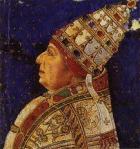 Savonarola opposed the Medici family, lords of Florence, and the Church of the Borgias. At the time, the Catholic Church was going through a period of extreme decadence. Under Pope Alexander VI, it had reached bottom. He had transformed Rome into a city-brothel which Luther compared to Sodom. And Savonarola was a bitter critic of the church: “In your lust you became a brash prostitute, you are worse than a beast, you are an abominable monster”.
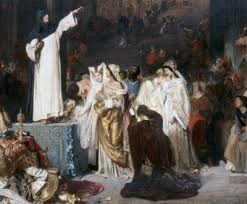 Savonarola was known for his prophecies of civic glory, and his denunciation of clerical corruption, despotic rule, and exploitation of the poor. At his urging, the Florentines expelled the ruling Medici family and established a brief republic. Savonarola instituted an extreme puritanical campaign. The Pope tolerated him for a while, and then banned him from preaching. Savonarola defied the Pope and continued his bonfires of the vanities. The Pope then excommunicated him.
Savonarola hinted at performing miracles to prove his divine mission. A rival Franciscan preacher proposed to test that mission by walking through fire. The first trial by fire in Florence in over 400 years was set for April, 1498. A crowd filled the central square eager to see if God would intervene. Delays in the contest and then a rainstorm forced the cancellation of the proceedings. The angry crowd blamed Savonarola for the fiasco.
 Popular opinion turned against the preacher. The Florentines captured him and demanded the return of the Medicis. In May of 1498, the Dominican friar was hanged and then burned at the stake in Florence with his brothers Domenico and Silvestro, on charges of heresy. The ashes were then dispersed in the Arno by the Ponte Vecchio.
 What is Savonarola’s legacy? The early Protestant reformers praised his religious ideas. In the mid-nineteenth century, the “New Piagnoni” found inspiration in the friar’s writings and sermons for Italy’s Risorgimento. By emphasizing his political activism over his puritanism and cultural conservatism, they restored Savonarola’s voice for radical political change. The Catholic Encyclopedia entry on Girolamo Savonarola concludes with, “In the beginning Savonarola was filled with zeal, piety, and self-sacrifice for the regeneration of religious life. He was led to offend against these virtues by his fanaticism, obstinacy, and disobedience. He was not a heretic in matters of faith.”

 L'Olivo Santa Barbara