
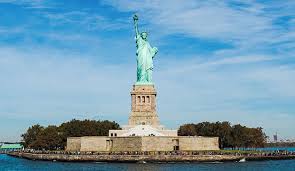
 The history of the Statue of Liberty is the story of 3 countries—France, the United States, and Italy— the turbulent times in these countries in the mid to late 1800s, and the bonds these countries shared then and now. As most Americans know, Liberty Enlightening the World was a gift from the French people in honor of the centennial of American independence. Dedicated in 1886, it proudly stands 305 feet tall (to the top of the torch) overlooking the bay in Manhattan.
 The statue was conceived in the 1870s by French sculptor Fréderic Auguste Bartholdi after the establishment of the French Third Republic to show the fraternal feeling between the republics of the United States and France. The Second French Republic had collapsed after the Franco-Prussian War. Bartholdi’s hometown in Alsace had passed into German control, which supposedly influenced Bartholdi’s great interest in independence, liberty, and self-determination.
 The inspiration for the statue brings us to Italy. Until now, many people thought that Bartholdi modeled Lady Liberty after a statue that stands on the balcony above the main entrance to the Duomo in Milan. Sculpted by Camillo Pacetti in 1810, this statue is 75 years older than the one in New York. Both hold a torch with their right hand, and both wear a crown and a tunic. The only difference is what they hold in their left hand. The one in Milan holds a cross, and the one in New York holds a book with the Independence Day date on it.
 But now comes word that Bartholdi’s statue in New York could be the “younger sister” of a monument in the Basilica of Santa Croce in Florence. “Freedom of Poetry” was sculpted by Pio Fedi and placed in the church in 1883 as a funeral monument in honor of the Risorgimento patriot, Giovanni Battista Niccolini. He was a poet and playwright of the Italian unification movement; his 1846 play, Arnold of Bresciawas written in support of unification.
Art in support of history, or in spite of it, brings us back to New York. The 1880s were difficult times in America. The threat of social revolution had become palpable. Striking workers led to violent clashes. Discrimination on the basis of race, gender, and ethnicity had long run deep, and now prejudice against foreign workers was joining these bigotries. Despite the abolition of slavery, African-Americans were still profoundly marginalized. Native Americans were being forced onto reservations. And now the Statue of Liberty became a flashpoint for suffragists who found it the ultimate expression of hypocrisy: it represented freedom as a majestic female form in a country in which not one woman was free to vote.
Yet, for many people around the world, the statue represents asylum and freedom for oppressed people. The monument does not feature the usual symbols of American  patriotism, such as the flag or the bald eagle. The tablet in Liberty’s left hand is not the U.S. Constitution; instead it represents the Declaration of Independence, the radical statement of individual and national liberty signed by the American revolutionaries. Six years after the Statue was installed, Ellis Island opened nearby, through which more than two million immigrants passed on their way to a new life in America. The immigration center closed in 1954 but on its site now stands the Ellis Island National Museum of Immigration.
 It is here that a special exhibition, “Sisters in Liberty” will be held in 2020 jointly sponsored by Florence and the United States. From a high-resolution 3D scan, a perfect reproduction of the statue in Florence, “Freedom of Poetry” will be displayed. The exhibition is also connected to the bicentennial of the presence of the American Consulate in Florence: “It is a profound bond that unites Santa Croce with the United States…and the closeness between the two sister statues is a symbol of this bond, today stronger than ever.”
 Il teatro: Chiesa di Santa Maria Maddalena a Castelnuovo Magra, un paese di meno di 8.500 abitanti nella provincia di La Spezia, nella regione Liguria.
 due uomini sono entrati nella chiesa vuota e si sono diretti verso la cappella laterale. Lì, in una teca vi era la preziosa “Crocifissione” di Bruegel il Giovane (1564-1638). Hanno lavorato velocemente. Hanno fracassato la teca con un martello, hanno rimosso il dipinto del valore di almeno 3 milioni di euro, e sono fuggiti in una Peugeot bianca. L’auto rombante ha attirato l’attenzione di un residente, che ha visto che la porta della chiesa spalancata, dando così l’allarme. Il prete, il sindaco e gli abitanti della città erano tutti sconvolti.

 L'Olivo Santa Barbara