San Pellegrino (in English)

San Pellegrino is one of the foremost brands of bottled sparkling water not only throughout Italy, but also throughout the world.  Since 1395, San Pellegrino Terme in the province of Bergamo (Lombardy) has been the source of the iconic waters that in the past were called “miraculous.”  Even Leonardo da Vinci visited the town in 1509 and later wrote a treatise on water.  Over the centuries, doctors recommended the waters for people with kidney, urinary tract and other diseases.
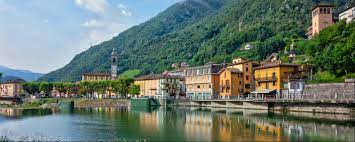
The journey of S. Pellegrino mineral water starts at 700 meters (2,300 feet) below the surface.  It flows from natural springs in the foothills of the Italian Alps.  It takes a total of 30 years to reach the surface.  This long journey makes the water naturally rich in mineral salts, calcium and magnesium.  When the water reaches the bottling plant in San Pellegrino Terme, it is not naturally carbonated.  At the beginning of the 20th century, carbon dioxide was added to prevent the development of bacteria, especially during long overseas travels.
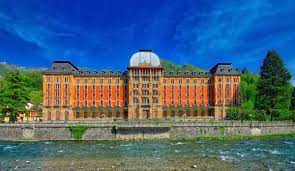
The San Pellegrino company was founded in 1899, and the spa opened the following year.  Soon thereafter the Grand Hotel and the Casinò, two architectural gems that are still standing, were built on opposite sides of the river Brembo.  And so, the heyday of San Pellegrino Terme began.  The European bourgeoisie flocked to the town for fun and entertainment, to sample the water, and to mix with the aristocracy.  Guests at the hotel included Queen Margherita of Savoy, the family of the Tsar of Russia, an entourage of King Farouk of Egypt and, in the 1960s, Federico Fellini and Giulietta Massina.
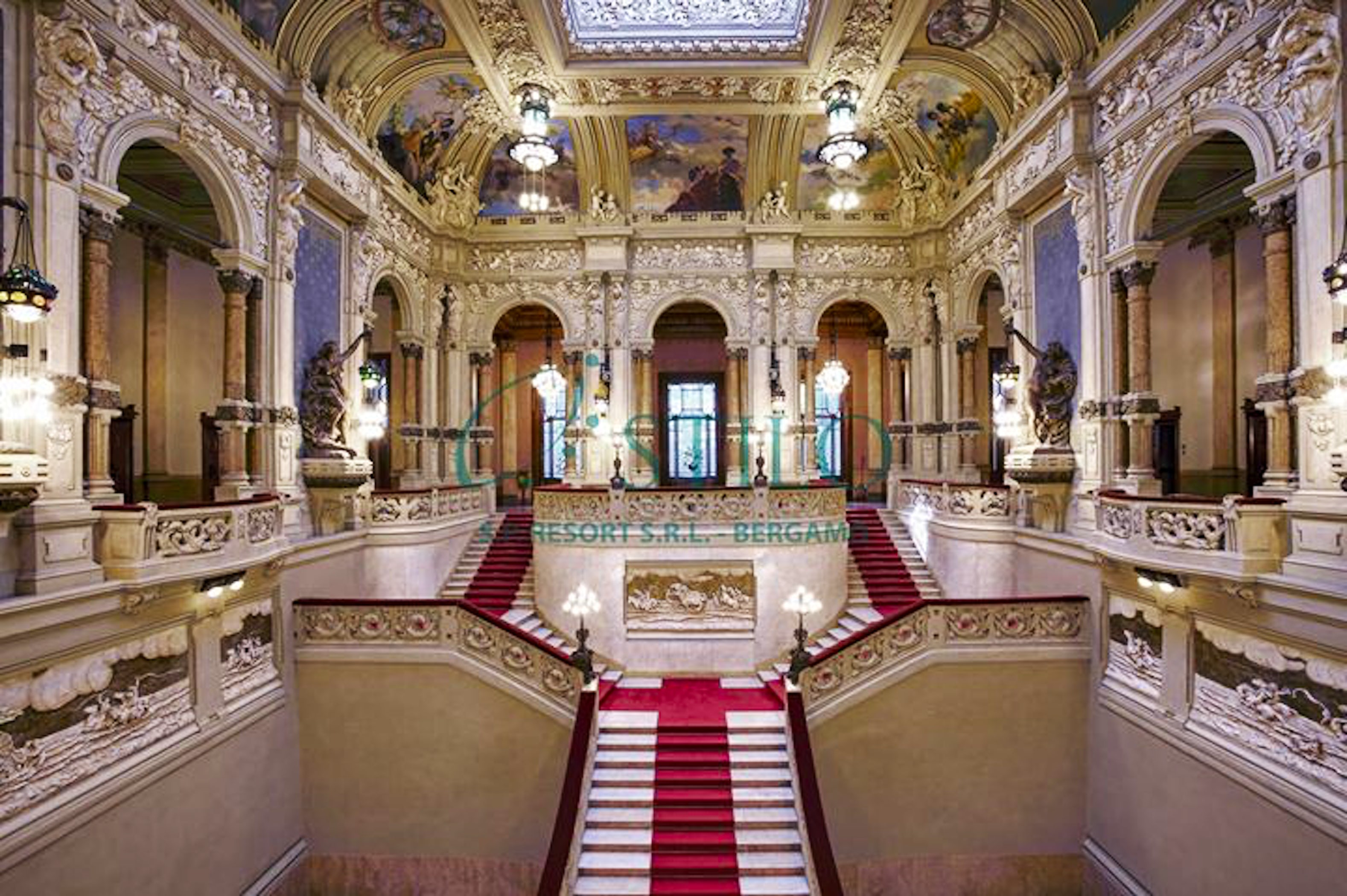
Both the Casinò and the Grand Hotel, designed by architect Romolo Squadrelli, represent magnificent examples of Art Nouveau (or Belle-Epoque) style.  The Casinò presents an imposing, yet graceful façade; inside it features a grand lobby with a massive split staircase, columns and intricate statues and frescoes.  Gambling operations ceased in 1946, and today the structure hosts theatrical and other cultural events, wedding receptions, gala evenings, business conventions and exhibitions.  The Grand Hotel is a huge 7-story building with 250 rooms; both the façade and furnishings are lavish with statues, caryatids, deities and garlands.  However, the high cost to maintain and renovate the hotel forced it closure in 1979.  It still awaits a savior.

Both the 20th and 21st century have seen many changes to the company.  Machinery introduced and upgraded since the 1930s increased productivity.  Beginning with Aranciata (orange), new flavors have been introduced.  In 1997 the company Sanpellegrino was bought by Perrier Vittel, a division of the Swiss-based Nestlé.  However, the brand is still sourced and bottled at San Pellegrino Terme.  In fact, 50,000 bottles of water are produced every hour in the San Pellegrino plant, for a total of one million bottles a day, which includes sparkling water and flavored soft drinks.

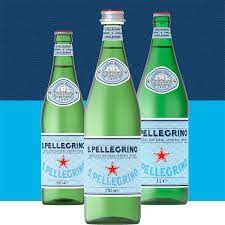
A plastic version of the bottle was introduced in 2012, but the shape of both glass and plastic has remained the same since its origin in 1899.  The packaging has maintained the original references to the territory: On the neck is a representation of the Casinò with the date of the founding below.  The label has a white and blue watermark reminiscent of the Belle Epoque style.  And the red star was a symbol of high-quality products exported from Italy between the 1800s and the 1900s.

Different versions of the label have been created for collaborations, such as the recent one with Stanley Tucci, American actor and host of the CNN food and travel documentary titled Stanley Tucci: Searching for Italy. Tucci is featured in a commercial for the water brand that was filmed at the Casinò.  The company also issued a “Stan Pellegrino” gift box that includes autographed copies of the iconic water.

Construction is currently under way on the San Pellegrino Factory of the Future, which will be both a sourcing, preparation and bottling facility, as well as a visitor’s center.  The design features archways and glass for views of the gorgeous surroundings, including the Alps and the Brembo river.  The Danish designers, the Bjarke Ingels Group, said that they are seeking to create “a framework for the purity and clarity of the mineral water in an environment characterized by lightness, openness and transparency.”

Posted in Alpe, Architecture, English, Foto, Italia, Lombardia, Storia | Leave a comment

La Scomparsa di Emanuela Orlandi

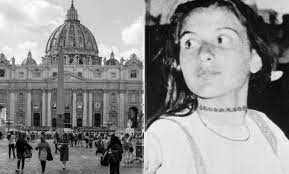
Nell’ottobre 2022, Netflix ha lanciato un documentario in quattro parti intitolato La Ragazza Vaticana: La Scomparsa di Emanuela Orlandi.  Racconta la vera storia di una ragazza quindicenne, cittadina della Città del Vaticano, scomparsa nell’estate del 1983.  Il mistero non è mai stato risolto, ma alla fine della serie si arriva a determinate ipotesi riguardo al destino di Emanuela.

Lei era la quarta di cinque figli in una famiglia che ha servito amministrati di sette Papi per secoli.  Suo padre era messaggero per la Banca Vaticana.  Emanuela era una studentessa di musica; suonava il pianoforte e la flauto e cantava in un coro alla scuola di musica, vicino a Piazza Navona, nei pressi del Vaticano.  La notte della scomparsa si stava recando alla scuola di musica per cantare e suonare il flauto.

L’agonia della famiglia è palpabile per tutto il documentario. Roma viene tappezzata di manifesti con la sua foto e di richieste di informazione. La famiglia e i Carabinieri hanno seguito indizio dopo indizio. Ciascuno degli episodi è incentrato su una o più teorie: due anni prima, un cittadino turco aveva sparato a Papa Giovanni Paolo II in Piazza San Pietro; presunti rapitori chiedevano di riscattarlo con Emanuela. Durante il periodo della Guerra Fredda, c’era persino il sospetto di un coinvolgimento del KGB. E a un certo punto sembrava certo che pure la mafia sapesse dove si trovava Emanuela.

Ma la storia torna più e più volte in Vaticano. Perché Papa Giovanni Paolo II è stato il primo ad annunciare il rapimento di Emanuela? Dove ha preso i soldi per finanziare il movimento Solidarnosc nel suo paese natale, la Polonia? La Banca Ambrosiana e la Banca Vaticana riciclavano denaro mafioso? E perché Papa Francesco ha detto a suo fratello Pietro che Emanuela è in cielo? Come spiegò il fratello Pietro, quelle quattro parole gli conficcarono un pugnale nel cuore. Ma il Papa si è rifiutato di dire altro.

Il fulcro del caso, secondo me, è un documento che un giornalista ha ottenuto durante il periodo dello scandalo VatiLeaks, iniziato nel 2012, che denunciava la corruzione del Vaticano. Il documento sembrava essere un rendiconto finanziario delle spese pagate per conto di Emanuela e comprendeva una cospicua spesa finale, presunta spesa per la sua sepoltura.

L’episodio finale ha sollevato una nuova teoria che punta ancora una volta il dito sul Vaticano. Una compagna di liceo di Emanuela racconta, in forma anonima, una conversazione telefonica in cui Emanuela confessa nervosamente che quando passeggiava nei giardini vaticani, un arcivescovo vicino al Papa la “infastidiva”. L’amica ha dichiarato che intendeva esplicitamente che si trattava di avance sessuali. Se così fosse, sarebbe la prima volta che del Vaticano ad aver adottato una cattiva condotta sessuale sul proprio suolo. E se così fosse, sarebbe stato motivo più che valido per mettere a tacere Emanuela.

Per tutto il documentario si prova un senso di tristezza travolgente verso la famiglia Orlandi. Poco prima che il padre morisse nel 2004, disse alla famiglia: “Sono stato tradito dalle stesse persone che ho servito”. La madre di 92 anni pensa a sua figlia ogni giorno della sua vita con la speranza di poter mettere un fiore sulla sua tomba prima che lei stessa muoia.

Per il resto, tutti noi siamo anche profondamente rattristati dal fatto che il potere della Chiesa sia molto più grande della vita di una giovane ragazza. Sul finire del documentario, viene da chiedersi se tutte le piste che la famiglia e i Carabinieri hanno seguito per decenni non siano state effettivamente orchestrate dal Vaticano per distrarre dal vero colpevole. Il Vaticano ha risposte almeno parziali, speriamo quindi che ci sia un quinto episodio che si spieghi queste connessioni.

Posted in Film, Foto, Italia, Italiano, Mafia, Musica, Roma, Storia, Vaticano | 1 Comment

The Disappearance of Emanuela Orlandi

In October 2022, Neflix released a 4-part docuseries called Vatican Girl: The Disappearance of Emanuela Orlandi.  It recounts the true story of a 15-year-old girl, a citizen of Vatican City, who disappeared in the summer of 1983.  The mystery has never been solved, but by the end of the series, we have a pretty good idea who has some answers to Emanuela’s fate.

She was the fourth of five children in a family that served for centuries under seven Popes.  Her father was a messenger for the Vatican Bank.  Emanuela was a music student; she played the piano and the flute, and sang in a choir at a music school just outside the Vatican near the Piazza Navona.  On the night of her disappearance, she was going to the school to practice singing and play the flute.

The agony of the family is palpable throughout the documentary.  Rome became plastered with posters of her picture and pleas for any clues.  The family and the Carabinieri followed lead upon lead.  Each of the episodes focuses on one or more theories:  Two years earlier, a Turkish national had shot Pope John Paul II in St. Peter’s Square; supposed kidnappers were demanding a prisoner swap of him for Emanuela.  During the time of the Cold War, there was even suspicion of KGB involvement.  And at one point, it seemed certain that the Mafia had a hand in her whereabouts.

But the story returns time and again to the Vatican.  Why was Pope John Paul II the first to announce that Emanuela had been kidnapped?  Where did he get the money to fund the Solidarity movement in his native country of Poland?  Were the Bank of Ambrosiana and the Vatican Bank laundering Mafia money?  And why did Pope Francis tell her brother, Pietro, that Emanuela is in heaven?  As Pietro explained, those four words stuck a dagger in his heart.  But the Pope refused to say anything more.

The crux of the case, in my opinion, is a document that a journalist obtained during the time of the VatiLeaks scandal, beginning in 2012, which exposed Vatican corruption.  The document appeared to be a financial accounting of expenses paid on behalf of Emanuela, and included a large final expense, which was presumed to be for her burial. 

The final episode raised a new theory that again points to the Vatican.  In it a high school friend of Emanuela’s anonymously recounts a telephone conversation in which Emanuela nervously confesses that when she walked in the Vatican gardens, an archbishop close to the Pope “bothered” her.  The friend said that she explicitly meant that it was a sexual encounter.  If so, this would be the first time that the Vatican could have been exposed for sexual misconduct on its own soil.  And if so, it would be an enormous motive to silence Emanuela.

Throughout, you feel an overwhelming sense of sadness for the Orlandi family.  Shortly before the father died in 2004, he told the family, “I was betrayed by the very people I served.”  Her mother, now 92, thinks of her daughter every day of her life with the hope that she can put a flower on her grave before she herself passes away. 

For the rest of us, we are also profoundly saddened that the power of the Church is so much greater than the life of one young girl.  As the documentary closes, you wonder if all the leads that the family and the Carabinieri followed for decades were actually planted by the Vatican to distract everyone from the real culprit.  The Vatican has at least partial answers, and we hope there is a fifth episode exposing those connections.              

Posted in English, Film, Foto, Italia, Mafia, Musica, Roma, Storia, Vaticano | 2 Comments