De mortuis nihil bonum: Of the dead (say) nothing by good

This post is based on the article, “Light in the Palazzo” by Ingrid D. Rowland in the New York Review of Books.  It is the second of three installments on the Torlonia marbles.

In the Golden Book of Italian Nobility, the Torlonia name is a late entrant.  Its noble titles date back only two hundred years, yesterday by Roman standards.  The story begins with Marin Tourlonias, a French merchant who changed his name to Marino Torlonia when he came to Rome in the mid-eighteenth century to sell fine fabrics at the foot of the Spanish Steps.  His son, Giovanni Raimondo went into the family business and also into banking, extending loans to aristocratic customers who bought his dry goods—loans often guaranteed by tracts of land, some of which were feudal properties with titles attached.

Napoleon’s arrival in 1798 caused an upheaval in the economy, which, in turn, caused many of Giovanni Raimondo’s clients to default and for the businessman / banker to acquire a string of fiefdoms. He became so rich that he was recognized as a Roman patrician and his name was entered into the Golden Book.  While most aristocratic titles originated as military titles, Torlonia bought his way into nobility—though he was not the first to do so.  Then in 1814 in gratitude for years of financial support, the pope gave him a title of his own, First Prince of Civitella Cesi.  Giovanni Raimondo Torlonia was now lord and master of real estate in and around Rome, in Tuscany, in Umbria, and in the mountains of Abruzzi.  In Rome he purchased and renovated several neoclassical palazzi and decorated them all with ancient statues and modern art. 

It was Giovanni Raimondo’s second son, Prince Alessandro, who increased their vast holdings of sculpture by buying up entire collections.  Prince Alessandro also bought a factory building on the Via della Lungara and transformed it into a museum.  The new seventy-seven-room Torlonia Museum stood across the street from a landmark of Renaissance Rome: the suburban villa of the merchant banker Agostino Chigi, a palace also filled with ancient art.  The museum opened in 1876 but only to visitors inscribed in the Golden Book. Prince Alessandro’s vast collection remained hidden, for the most part, until the 2021 exhibition of 92 masterpieces were unveiled at the Palazzo Caffarelli in Rome’s Capitoline Museums. 
Even the catalog to the exhibition of “Torlonia Marbles: Collecting Masterpieces” does not reveal a sad 20th-century story about the entire collection of 620 statues, sarcophagi, busts, vases and reliefs. In 1968, the great-grandson of the original collector, another Prince Alessandro Torlonia, received a permit to repair the roof of the family’s sprawling private museum.  Prince Alessandro had a construction fence erected around the Torlonia Museum and turned its galleries into 93 mini-apartments.  He crammed the displaced antiquities into three storerooms in Rome, which one journalist described as “stacked on top of each other like junk.”  In 1977 a Roman magistrate charged Prince Alessandro with illegal construction and damaging cultural heritage, charges that gave the government the ability to sequester the building and also the collection.  But, as is too often the case, the statute of limitations expired and all was restored to the owner.  However, the charge of damage to Italy’s cultural heritage went to the country’s Supreme Court, which ruled in 1979 that “the transfer [to storage] inflicted material and immaterial damage to the collection,” and that the statues were kept “in cramped, inadequate, dangerous quarters…condemned from a cultural standpoint to certain death.”  Prince Alessandro responded by letting the Torlonia marbles continue to languish under a growing layer of dust, shrouded in plastic and malign neglect.

For decades the Italian government tried to reach an agreement with the Torlonia family to either display or sell the works.  Negotiations failed until a breakthrough came in 2016 with an accord to display the works that resulted in the 2021 exhibition.  Prince Alessandro died in 2017 but he did establish a Foundation run by his grandson to manage the family’s artistic patrimony.  According to Ingrid Rowland in the New York Review of Books, the catalog for the exhibition is befitting the momentous occasion – it is stylish, informative, and complete in every respect except one: Prince Alessandro has been given the benefit of the ancient Roman rule de mortuis nihil nisi bonum, of the dead, say nothing but good, that is, it is socially inappropriate to speak ill of the dead as they are unable to justify themselves.   
Posted in Architecture, Arte, English, Foto, Italia, Roma, Storia | Leave a comment

I marmi Torlonia

Questa è una storia di molte storie. Ma, prima di tutto si tratta proprio della storia dei marmi Torlonia. Nell’aprile 2021, 92 capolavori sono stati presentati a Palazzo Caffarelli, ai Musei Capitolini di Roma. La mostra, denominata “I Marmi Torlonia: Collezionare capolavori”, rappresenta la più grande e importante collezione privata di arte antica del mondo. Rivaleggia con quelli dei grandi musei del mondo ed è seconda solo ai Musei Vaticani, per dimensioni e qualità dell’arte. L’intera collezione, di 620 pezzi, comprende statue, sarcofagi, busti, vasi e rilievi databili dal V secolo a.C., al IV secolo d.C. .

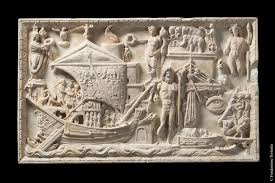
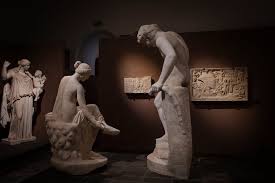
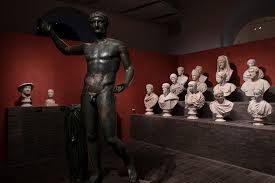
La mostra si apre con una panoplia di busti, oltre all’unico bronzo della collezione, una statua del primo secolo d.C. del generale romano Germanico, addossata a pareti di colore rosso pompeiano. Le stanze successive presentano un satiro e una ninfa in ballo, l’abbraccio di Eirene e Ploutos e un fantastico bassorilievo con vista del tempio della pace di Portus Augusti. Queste opere rappresentano quelle portate alla luce nel corso dell’Ottocento, con scavi nei pressi di Torlonia vicino a Roma, nella zona della Sabina e nel Viterbese. Ma, la maggior parte dell’intera collezione è stata raccolta acquisendo collezioni – in tutto o in parte – da famiglie aristocratiche italiane in difficoltà finanziarie. Tali raccolte, a loro volta, avevano al loro interno un numero significativo di opere provenienti da collezioni risalenti alla Roma del XVI secolo. Quindi l’intera mostra è descritta come “una raccolta di collezioni”, che rappresenta uno spaccato della storia del collezionismo di antichità.

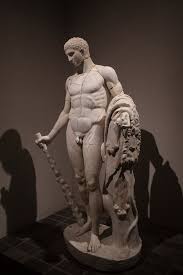
Questo progetto ha anche rivelato nuove intuizioni sulla scultura classica. Prima di essere esposte, le sculture venivano rifinite e pulite. La mostra è sponsorizzata dal marchio di lusso italiano Bulgari, che ha permesso di restaurare molte opere. Anche se le sculture classiche erano spesso dipinte con colori vivaci, è raro oggi trovare prove dei pigmenti originali, o perché si sono sbiaditi nel tempo o perché i collezionisti preferivano superfici incontaminate. Secondo la restauratrice responsabile della collezione Torlonia, Anna Maria Carruba, registrare gli interventi storici è stato il compito più impegnativo. Per esempio: in mostra una grande statua di capra a riposo della fine del I secolo a.C.; la testa dell’animale però risale ad epoca successiva ed è attribuita all’artista barocco Gian Lorenzo Bernini. La mostra si conclude con una statua di Ercole, spogliata della sua patina antica per rivelare “un puzzle” composto da 125 pezzi, appartenenti ad almeno due diverse statue antiche che sono state ricongiunte in epoche diverse. Era stata rivestita per dare il senso di scultura unica, e tale procedura non era insolita nel passato. La statua rappresenta non solo le diverse pratiche del passato, ma anche le sfide che devono affrontare oggi collezionisti, restauratori e archeologi.

Le origini di questa collezione risalgono alla famiglia Torlonia, che accumulò una fortuna durante i secoli XVIII e XIX, attraverso l’amministrazione delle finanze del Vaticano. La famiglia mantenne privata la sua collezione; ma, nel 1875 il principe Alessandro Torlonia allestì un museo privato per mettere in mostra gli antichi marmi, ma la collezione era visibile solo a famiglie nobili e su invito personale. Il resto del mondo intravide le statue solo attraverso le fotografie di un catalogo, pubblicato nel 1884.

Ma la storia non finì così. La collezione finì in alcuni magazzini a Trastevere, nel secondo dopoguerra. (Questa storia verrà raccontata nel post della prossima settimana). Lo stato italiano cercava di raggiungere un accordo con la famiglia Torlonia per esporre o vendere le opere, ma le trattative rimasero ferme per decenni. Nel 2013, l’ultimo principe, Alessandro Torlonia (scomparso nel 2017) ha costituito una Fondazione per la gestione del patrimonio artistico della famiglia. La Fondazione, gestita dal nipote del principe, Alessandro Poma Murialdo, è arrivata ad una svolta nel 2016: stato italiano ed eredi della famiglia hanno firmato un accordo per esporre le opere. L’accordo prevede anche che la collezione faccia un tour all’estero, ma la pandemia ha ritardato l’inizio della mostra. “Il tour internazionale è stato per noi una parte essenziale dell’accordo sin dall’inizio … È importante che la collezione sia condivisa a livello internazionale”, ha dichiarato l’erede Poma Murialdo.

Posted in Architecture, Arte, Foto, Italia, Italiano, Roma, Storia, Vaticano | 1 Comment

The Torlonia Marbles

This is a story of many stories.  First and foremost, it is about the Torlonia marbles themselves.  In April 2021, 92 masterpieces were unveiled at the Palazzo Caffarelli in Rome’s Capitoline Museums.  Called the “Torlonia Marbles: Collecting Masterpieces,” this exhibition represents the largest and most important private collection of ancient art in the world.  It rivals those in the world’s great museums and is second only to the Vatican Museums in the size and quality of the art.  The entire collection of 620 pieces includes statues, sarcophagi, busts, vases and reliefs dating from the 5th century BC to the 4th century AD.

The exhibition opens with a panoply of busts, as well as the collection’s only bronze, a first century AD statue of the Roman general Germanicus—set against walls of Pompeian red.  The next rooms feature a satyr and nymph in dance, the embrace of Eirene and Ploutos, and a fantastic bas-relief with a view of the time of peace by Portus Augusti.  These works represent those brought to light during the 19th c. excavations of the Torlonia’s lands near Rome, in Sabina and in the Viterbo area.  But the bulk of the entire collection was assembled by acquiring collections—in whole or in part—from aristocratic Italian families in financial straits.  Those collections, in turn, had within them a significant number of works from collections dating back to 16th century Rome.  Hence the entire display is described as “a collection of collections,” which represents a cross-section of the history of collecting antiquities.

This project also revealed new insights into classical sculpture.  Before going on display, the sculptures had been researched and cleaned.  Supported by the Italian luxury brand Bulgari, conservation of one marble relief depicting a harbor still had traces of its original painted surface.  Even though classical sculptures were often brightly painted, it is rare today to find evidence of the original pigments—either because they faded over time or because collectors preferred pristine surfaces.  According to the conservator of the Torlonia collection, Anna Maria Carruba, recording historic interventions was her most challenging task.  In the exhibition is a large resting goat statue from the end of the 1st century BC; however, the head is from a later period and is attributed to the Baroque artist Gian Lorenzo Bernini.  The exhibition concludes with a statue of Hercules stripped clean of its patina to reveal “a puzzle” composed of 125 pieces belonging to at least two different ancient statues that were brought together in different eras.  It had been coated to give the sense of one sculpture, which was not an unusual process in the past.  The statue represents not only practices of the past but also the challenges facing today’s conservators, restorers and archaeologists.

The origins of this collection date back to the Torlonia family that amassed a fortune during the 18th and 19th centuries through administration of the Vatican’s finances.  The family kept its collection private; in 1875, Prince Alessandro Torlonia set up a private museum to showcase the ancient marbles, but the collection was visible only to other noble families by special appointment.  The world glimpsed the statues only through photographs in a catalogue that was published in 1884. 

The mystique grew.  The collection ended up in storerooms in Rome after World War II.  (This story will be told in next week’s post).  The Italian government tried to reach an agreement with the Torlonia family to either display or sell the works, but the negotiations stalled for decades.  In 2013 the most recent Prince Alessandro Torlonia (who died in 2017) set up a Foundation to manage the family’s artistic patrimony.  The Foundation is run by the prince’s grandson, Alessandro Poma Murialdo.  Then came a breakthrough in 2016: the Italian government, the family heirs, and the foundation signed an accord to display the works.  The deal also stipulates that the collection will tour abroad, but the pandemic has delayed the decisions on which countries and institutions.  “The international tour was for us an essential part of the accord from the start…It’s important that the collection be shared internationally,” said Poma Murialdo.

Posted in Architecture, Arte, English, Foto, Italia, Roma, Storia, Vaticano | 1 Comment