Art Looting under Napoleon: Part II

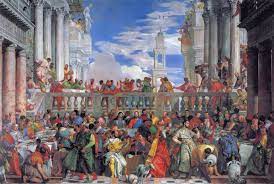
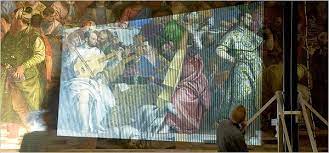
In Venice in 1562, the monks of San Giorgio Maggiore commissioned Paolo Veronese to undertake a monumental painting to decorate the far wall of the monastery’s new refectory, designed by the architect Andrea Palladio.  Finished a year later, The Wedding Feast at Cana depicts the biblical story of the Marriage at Cana, at which Jesus converts water to wine.  Executed in the Mannerist style of the late Renaissance, the painting shows the sumptuous feasts of food and music that were characteristic of 16th-century Venetian society.  The crowded banquet scene is framed with Greek and Roman architecture from classical antiquity and from the Renaissance.  In accordance with artistic tradition at the time, Veronese included himself in the banquet scene, as the musician in the white tunic.  Among the other musicians in the painting are the painters Tintoretto playing a viola da braccio and Titian, dressed in red, playing the violone.

Painted in situ, The Wedding Feast at Cana is a monumental work measuring 22 feet by 32 feet.  It is meant to be viewed from below, because the painting’s bottom edge was 2.50 meters from the refectory floor, behind and above the head-table of the abbot of the monastery.  The painting filled the huge wall until Napoleon turned the monastery into his Venetian headquarters in 1797.  He wanted the painting transferred to Paris.  Venice’s chief restorer warned that the painting was far too large and far too fragile to be moved.  It weighed 1.5 tons.  But Napoleon’s men could not be dissuaded.  The artwork was brazenly removed, wrapped in paintings by Tintoretto, Titian and Veronese and shipped off. 

Upon arrival in Paris, French conservators cut the painting in two to reline it and then stitched it back together before it was hung in the refurbished great hall in the Louvre.  When Napoleon decided to use that hall for his wedding to Marie-Louise of Austria in 1810, it interfered with his plans and he ordered it to be destroyed: “Since it cannot be moved—burn it.”  The curators at the time ignored his command. 

After Napoleon’s abdication, owners of stolen art attempted to get their property back.  Pope Pius VII appointed the neoclassical sculptor Antonio Canova to negotiate the French repatriation of art plundered from the Papal States.  Although some items were returned, the French were reluctant to give up their trophies.  They claimed that The Wedding Feast at Cana was too large and fragile to be moved.  Yet, it was subsequently stored in a box in Brittany during the Franco-Prussian War (1870-71) and was rolled up for storage during the Second World War, continually moving to hiding places throughout the south of France to avoid Nazi plunder. 

Whether or not you agree with a scholar who called Napoleon’s pillage “a crime against humanity,” his brazen seizure of art from other lands certainly undermined the Louvre’s lofty civic ideals.  Today The Wedding Feast at Cana is the most expansive picture in the paintings collection of the Louvre and shares the same gallery as the Mona Lisa (which Da Vinci had sold to the king of France).  In 2007 on the 210th anniversary of its looting, a computer-generated, digital facsimile of The Wedding Feast at Cana was hung in the refectory of the Monastery of San Giorgio Maggiore, Venice.  It is a full-sized (more than 704 square feet) digital facsimile composed of 1,591 graphic files.
Posted in Architecture, Arte, English, Foto, Italia, Storia, Uncategorized, Venezia | 1 Comment

Spoliazioni napoleoniche: Parte I

Il saccheggio esiste fin dall’antichità. I romani iniziarono tale pratica che è durata per più di 2000 anni. Dopo i romani divenne attività comune rubare i tesori ai vinti per indebolirne lo status. Il bottino forniva anche fondi per finanziare le campagne militari. Successivamente, il saccheggio divenne motivo accettabile per iniziare una guerra, tanto per i Vichinghi quanto per i Conquistadores, come per i principi medievali.

Napoleone Bonaparte non fu il primo, né l’ultimo condottiero a rubare opere d’arte ai territori conquistati. Mentre Adolf Hitler è stato il più grande saccheggiatore in tempo di guerra, Napoleone e le sue truppe saccheggiarono opere d’arte su scala epica. Eppure, poco prima che Napoleone entrasse in scena, la Francia rivoluzionaria stava già impadronendosi di preziose opere d’arte per coronare il Museo del Louvre. Le grandi opere d’arte europee ora appartenevano al popolo, non solo a re e papi. Il museo fu aperto nel 1793 con opere per lo più sottratte a collezioni reali francesi ed alcune proprietà della Chiesa. Ma dove trovarne di più? I nuovi governanti francesi decisero che altri beni artistici sarebbero stati “liberati” con le loro conquiste. Giustificarono l’appropriazione di capolavori non solo con la convinzione che il bottino di guerra appartenesse al vincitore, ma anche con la convinzione che la Francia fosse il posto migliore per loro: “La Repubblica francese, per la forza e la superiorità del suo illuminismo e dei suoi artisti, è l’unico Paese al mondo che può dare una dimora sicura a questi capolavori”.

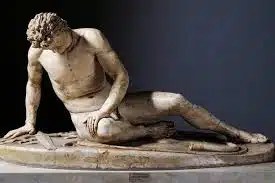
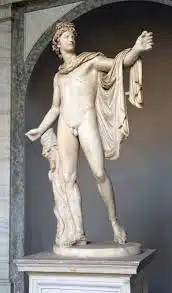
Il Napoleone in cerca di gloria abbracciò questo stilo per arricchire il nuovo museo francese. Nel 1796 il suo esercito attraversò l’Italia sottraendo tesori alle città vinte. Le acquisizioni erano molto ben organizzate, le opere erano selezionate da specialisti e i sequestri avvenivano attraverso trattati di pace. Anche il Vaticano fu tenuto a consegnare preziosi manoscritti e a pagare il trasporto per Parigi dei tesori confiscati. Con il trattato di Tolentino del febbraio 1797, i commissari francesi potevano entrare in qualsiasi edificio, pubblico, privato o religioso, per confiscare opere artistiche. Tra le sculture antiche consegnate dal Vaticano c’erano l’Apollo del Belvedere, Laocoonte e i suoi figli e il Gallo morente.  Napoleone scrisse: “Il comitato degli studiosi ha ottenuto un buon raccolto a Ravenna, Rimini, Pesaro, Ancona, Loreto e Perugia. Unito a quello che manderemo da Roma, che ci darà tutto il bello d’Italia tranne poche cose a Torino e a Napoli”.

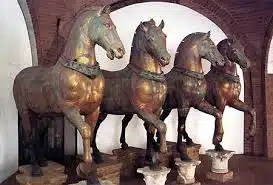
Nel maggio 1797 le truppe di Napoleone giunsero a Venezia. Si impadronirono del leone alato di Piazza San Marco e dei famosi quattro cavalli della Basilica di San Marco, per essere collocati in cima all’Arco di Trionfo a Parigi. Altre opere d’arte saccheggiate furono Le nozze di Cana (di cui parleremo nella seconda parte) e altri dipinti di Veronese, Tiziano e Tintoretto.

Il bottino di guerra italiano fu fatto sfilare per le strade di Parigi in una cosiddetta “Festa della Libertà” nel luglio 1798.  Lo stendardo sul carro che trasportava l‘Apollo del Belvedere portava la scritta: “La Grecia li ha ceduti, Roma li ha perduti. Il loro destino è cambiato due volte; non cambierà più”.  Le opere erano destinate al nuovo museo nazionale del Louvre, ribattezzato Le Museé Napoleon nel 1802.

Posted in Architecture, Arte, Foto, Italia, Italiano, Storia, Uncategorized, Vaticano | Leave a comment

Art Looting under Napoleon: Part I

Looting has been around since ancient times.  The Romans established a precedent that lasted more than 2,000 years.  After the Romans it became standard practice to remove treasures from the vanquished in order to weaken their status.  Booty also provided funds to pay for military campaigns.  Subsequently, looting became an acceptable reason to start a war, from the Vikings to the Conquistadors, to medieval princes.

Napoleon Bonaparte wasn’t the first or the last leader to steal art from conquered territories.  While Adolf Hitler was the largest wartime looter, Napoleon and his troops pillaged art on an epic scale.  Yet, just before Napoleon came on the scene, Revolutionary France was already seizing valuable art works for its crowning achievement:  The Louvre Museum.  Europe’s great artworks would now belong to the people, not just kings and popes.  The museum opened in 1793 with artwork mostly taken from the French royal collections and Church property.  But where to get more?  France’s new leaders decided that paintings would be “liberated” by conquest.  They justified the art appropriation not only by the belief that the spoils of war belonged to the victor, but also by the belief that France was the best place for art: “The French Republic, by its strength and superiority of its enlightenment and its artists, is the only country in the world which can give a safe home to these masterpieces.”

The glory-seeking Napoleon embraced this way to enrich the new French museum.  In 1796 his army swept through Italy seizing treasures from vanquished cities.   The acquisitions were highly organized, the art was selected by specialists, and the seizures took place through peace treaties. The Vatican too was required to relinquish valuable manuscripts and to pay for the transportation of the confiscated treasures to Paris.  In the February 1797 Treaty of Tolentino, French commissioners could enter any building—public, private, or religious—to confiscate artistic works.  Among the ancient sculptures surrendered by the Vatican were the Apollo Belvedere, Laocoön and His Sons, and the Dying Gaul.  Napoleon wrote: “The committee of scholars has reaped a good harvest at Ravenna, Rimini, Pesaro, Ancona, Loreto and Perugia.  Joined to what we shall be sending from Rome, that will give us everything of beauty in Italy except for a few things at Turin and Naples.”

By May 1797, Napoleon’s troops reached Venice.  They removed the winged lion from St. Mark’s Square and the famous four horses from St. Mark’s Basilica, which were eventually placed on top of the Arc de Triomphe du Carrousel in Paris.  Other plundered art included The Wedding Feast at Cana (to be discussed in Part II), and other paintings by Veronese, Titian and Tintoretto. 

The Italian war booty was paraded through the streets of Paris in a “Festival of Liberty” in July 1798.  A banner on the cart carrying the Apollo Belvedere proclaimed: “Greece ceded them, Rome lost them.  Their fate has changed twice; it will not change again.”  The art was destined for the new national museum at the Louvre, which was renamed Le Museé Napoleon in 1802.

Posted in Architecture, Arte, English, Foto, Italia, Storia, Vaticano | Leave a comment