
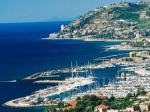
 Sanremo is a beautiful coastal city in Liguria and a popular tourist destination on the Italian Riviera. It hosts the annual Sanremo Music Festival, founded in 1951, which is so popular among Italians today that it is often referred to simply as “Il Festival.” The Festival was barely known until 1958 when Domenico Modugno sang “Nel blu dipinto di blu.” It was the last day of the
  Festival and he was declared the winner, which stunned the woman who until that moment had been considered the undisputed winner. Modugno wrote the song with Franco Magliacci, and it is said that Modugno did not want to sing it at the Festival, but did so only because it was turned down by all the singers to whom it had been proposed.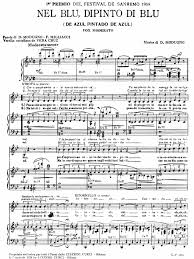
The song became an instant international success. It was the best-selling Italian single of 1958, and in the United States it remained at the top of the standings for five weeks, which has never happened to another song written in Italian. The following year, Modugno’s recording became the first Grammy winner for Record of the Year and Song of the Year. It has been translated into many languages and  recorded by diverse artists, including Dean Martin, David Bowie, and Paul McCartney, as well as Pavarotti and Bocelli.
Legend and a bit of magic are interwoven into the history of the song. Magliacci started working on the lyrics in the summer of 1957. One day he had planned to go to the sea with Modugno and while waiting for him to arrive, he started drinking wine and eventually fell 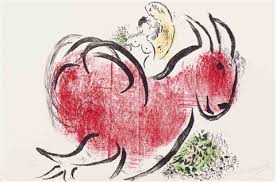 asleep. He had vivid dreams and when he awoke, he looked at the two Chagall reproductions on the wall of his room. In “Le coq rouge” a yellow man is suspended in midair and in “Le peintre et la modelle,” half the painter’s face is colored in blue. So he starts writing a song about a man who dreams of painting himself blue, and being able to fly. Much later Modugno’s wife recalled that after a storm forced open his window, Modugno got the idea of modifying the chorus of the song, introducing the word “Volare,” which is now the popular title of the song.
The song has an almost surreal beginning: “Penso che un sogno così non ritorni mai più. Mi dipingevo le mani e la faccia di blu; poi d’improvvviso venivo dal vento rapito, e incominciavo a volare nel cielo infinito.” “I think that a dream like this will never return; 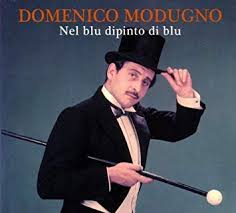 I painted by hands and my face blue, then was suddenly swept up by the wind and started to fly in the infinite sky.” Only at the end does it reveal itself as a love song: “Ma io continuo a volare negli occhi tuoi belli, che sono blu come il cielo trapunto di stelle” and “nel blu dipinto di blu, felice di stare quaggiù…con te.” “But I continue to fly in your beautiful eyes, which are blue like the sky quilted with stars” and “in the blue painted in blue, happy to stay down here with you.”
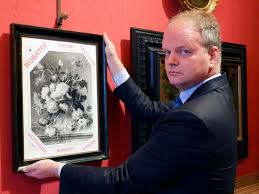 Nel gennaio 2019, un video delle Gallerie degli Uffizi a Firenze mostra il proprio direttore mentre appone drammaticamente una foto, in bianco e nero di un dipinto, sul muro di una galleria. Intorno alla foto, in grassetto rosso, ruota la parola “rubato” in tedesco, in italiano e in inglese insieme a una didascalia che spiega che l’opera d’arte originale fu rubata dai soldati nazisti durante la seconda guerra mondiale.
 Al suo posto oggi c’è la fotografia provocatoria, che fa parte della campagna mediatica degli Uffizi per sollecitare la Germania a restituire il dipinto rubato. Eike Schmidt, il primo direttore straniero degli Uffizi è lui stesso tedesco ed ha fatto un lungo appello su Twitter “Appello alla Germania del 2019”, dicendo fra le altre cose che “la Germania ha il dovere morale di restituire questo dipinto al nostro museo”. Le richieste digitali includono hashtag provocatori come #Nazis e #Wehrmacht.
 Ciò ha provocato molta indignazione. I pubblici ministeri italiani e un nucleo speciale dei Carabinieri che indagano sui furti d’arte, hanno aperto indagini sull’esportazione del dipinto da quando è stato prelevato dall’Italia nel 1944. Stanno anche valutando se la richiesta di denaro da parte della famiglia tedesca possa essere considerata un’estorsione. “Ciò che appartiene allo Stato italiano deve essere restituito allo Stato italiano”, ha dichiarato il comandante dei carabinieri per la Tutela del Patrimonio Culturale. E Schmidt ha affermato con fermezza: “Stiamo cercando di convincere la famiglia tedesca a capire che non siamo in una posizione legale per comprare qualcosa che secondo le leggi italiani e internazionali già possediamo”.
 Schmidt sostiene che generare pubblicità sull’opera “Vaso di fiori” dovrebbe rendere difficile la vendita del dipinto da parte della famiglia tedesca. “Grazie alla foto drammatica nel sala dei Putti, la gente saprà sempre che quest’opera d’arte è stata rubata e grazie anche alla pubblicità sui social nessuno in futuro potrebbe dire: ‘Ho acquistato questa opera d’arte in buona fede’”.
 L'Olivo Santa Barbara