
The Medici Chapels are structures adjoining Brunelleschi’s Basilica of San Lorenzo in Florence, which was considered the “official” church of the Medici family. Several family members are buried in the Old Sacristy. Cardinal Giulio de Medici, the future Pope Clement VII, wanted to erect a proper family mausoleum and hired Michelangelo to design the New Sacristy in 1520. Two mysterious stories have evolved from here.
In 1530, Michelangelo disappeared for three months while working on the Chapels. His whereabouts remained a secret for almost 500 years, but one theory has emerged. By 1527 Florentines had grown weary of the Medici, one of the wealthiest and most powerful families in Europe. Hoping for a more democratic government, rebels organized a popular revolt and drove the ruling family out of Florence. Michelangelo joined the rebels working to help fortify the city walls against the Medici forces.
Why would Michelangelo join the rebels? He owed his very livelihood to the Medici family, who commissioned his art including the very project he was working on. After 10 months of struggle, the Medici family won, and the rebels were swiftly punished. Michelangelo would have been punished too had he not found a hiding place. By 1530, the Pope let it be known that Michelangelo could return to work—unpunished—to complete the Chapel. Only then did he emerge from his hiding place.
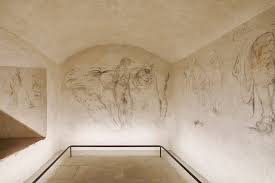
Fast forward to 1975. The director of the Medici Chapels Museum was searching for a new way for tourists to exit the museum. He and his colleagues discovered a trapdoor hidden beneath a wardrobe near the New Sacristy. Below the trap door, stone steps led to a room that appeared at first to simply store coal. They wondered if something interesting might be underneath the plaster walls. Experts spent weeks meticulously removing the plaster with scalpels.

What emerged were dozens of charcoal and chalk drawings believed to be the work of Michelangelo in the room where he may have hidden during the revolt. Some sketches are similar to his most famous works, including the statue of David, paintings in the Sistine Chapel, and a statue adorning a Medici tomb in the Sacristy above. He apparently filled his solitude with reflections on old works, as well as sketches of those he wanted to do once he survived those dramatic months.
Apart from questions about how he survived in this space, there are doubts about the provenance of these drawings. As with any unsigned artwork, it is impossible to confirm the origins with absolute certainty. Some art critics believe that the doodles are too amateurish to be Michelangelo’s. Others are convinced that in this 7- by 2-meter secret room is the major artistic find of the 20th century. Supposedly Michelangelo recalled his time there: “I hid in a tiny cell, entombed like the dead Medici above, though hiding from a live one. To forget my fears, I filled the walls with drawings.”

Since the discovery of the drawings in 1976, the secret room has been open mostly for scholars. In 2013, touch screen computers made the treasures visible to a wider audience. Now nearly 50 years after the discovery, the room has been open to the public. Due to the size of the room and to protect the drawings, visits will be kept to groups of four and limited to 15 minutes.

 L'Olivo Santa Barbara
absolutely fascinating. As usual. Thanks for the great “reveal”. Anne
Amazing they’ve opened it to the public. I wonder wh