
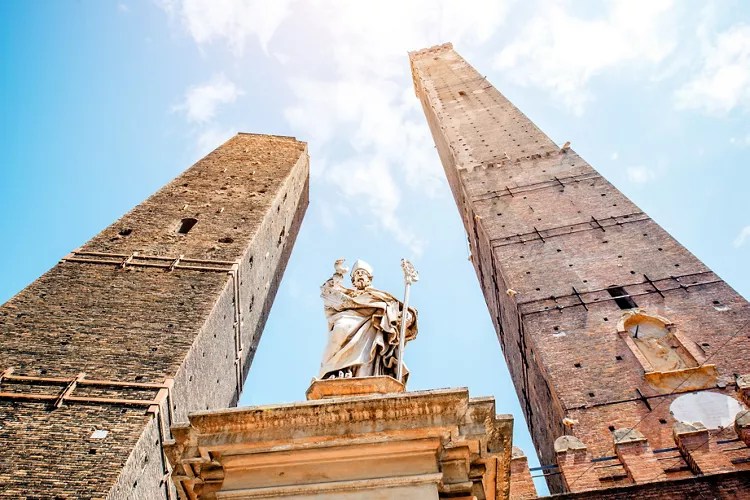
October 2023: The Garisenda Tower in Bologna’s city center is on “high alert” for collapse. No one knows when it could happen—three months, a year, 5 or 10 years. The alert is yellow. A red alert would imply an imminent problem.
A scientific committee has monitored the site since 2019. Sensors furnish readings every 15 minutes. Last month, readings revealed un unexpected and accelerated trend in compression at the tower’s base.

The Garisenda Tower is one of the famous “twin towers” of the city. Today the tower stands at 158 feet, and the nearby Asinelli Tower is almost twice as tall at 319 feet. Both were constructed in the 12th century when Bologna was like a mini-Manhattan with dozens of towers. Each one was constructed by a local family that tried to construct its own tower taller than the preceding one.
The ground and the foundation of Garisenda probably began to sink soon after it was built because of a construction error. In the middle of the 1300s, the tower was shortened for fear that it would collapse. Its leaning even scared Dante Alighieri who in “Inferno” of La Divina Commedia compared it to the appearance of a giant, Antaeus.
Garisenda leans at a four-degree angle, a little less than the five degrees of the Leaning Tower of Pisa. The trend could have been accelerated by extreme weather conditions, including the high temperatures of last summer and the floods at the beginning of 2023. Like all towers and skyscrapers, Garisenda has always swayed slightly. Even the experts on the scientific committee – geologists, engineers, architects, and chemists – do not all agree on the causes of the problem nor the solutions, which could take years, if not decades, to complete.
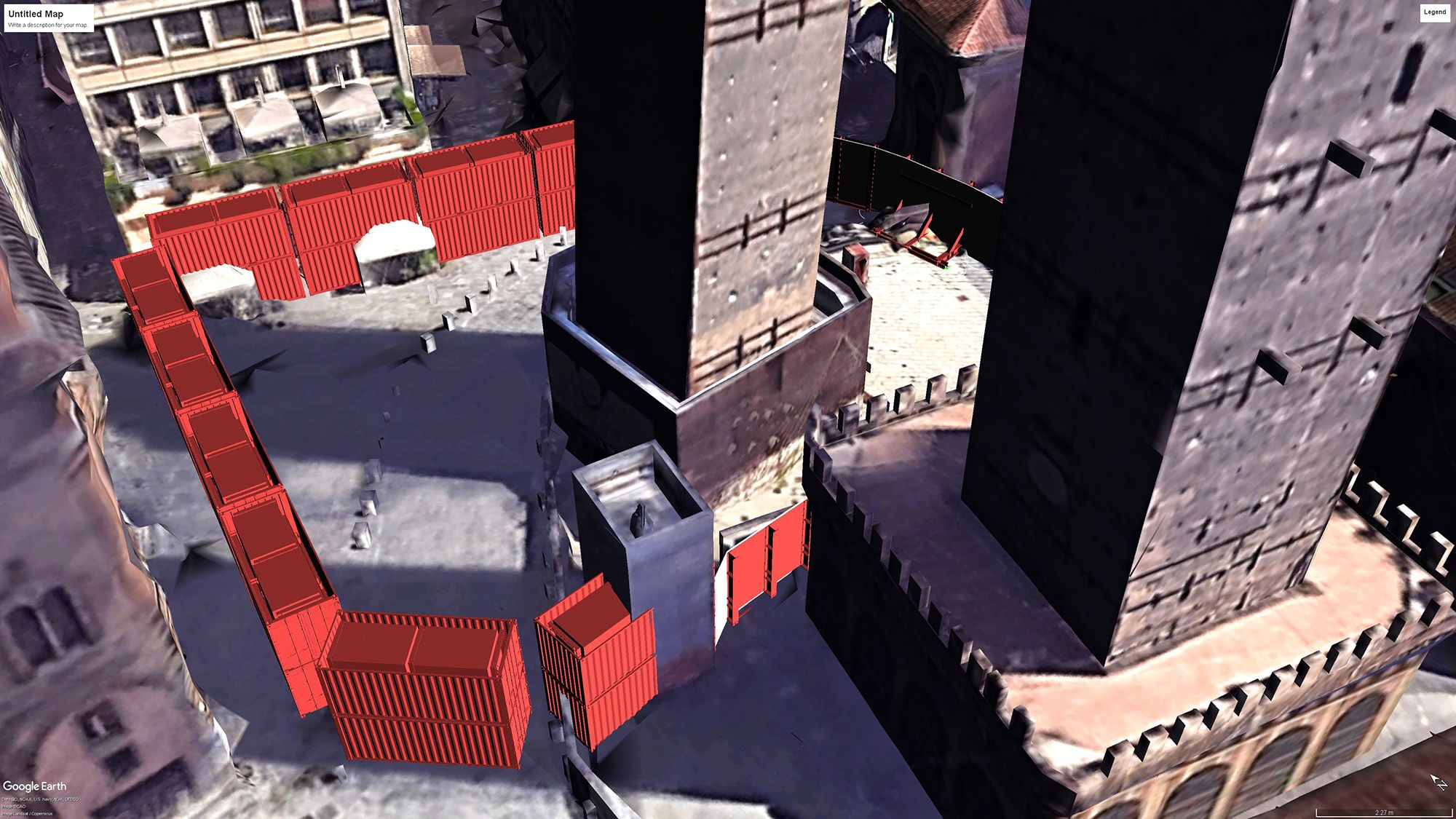
In the meantime, the area around the towers has been cordoned off to isolate them for reasons of both research and safety. Tourists can no longer climb the 498 steps of Asinelli, which is also being monitored by sensors. Tourism has grown exponentially in this bustling city of the north. The closure of the center is affecting traffic, at a time when the city is constructing new tram lines. The mayor hopes to take this opportunity to redesign mobility around the city, making it more pedestrian-friendly.
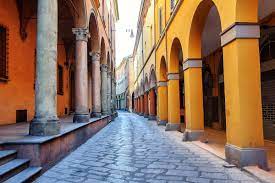
Like the porticoes of Bologna, the Twin Towers are important symbols of Bologna. In 2021, the porticoes became a UNESCO world heritage site. Constructed in wood, stone, or brick, they cover about 39 miles of streets, piazzas, paths, and walkways in the city. Although they offer pleasant walks protected from the rain and sun, originally, they weren’t designed to offer shelter from the elements, but to offer more space to the thousands of students that began to arrive at the beginning of the 13th century without university accommodation. Local residents decided to add extra room to their buildings by extending the first floor and not the ground floor.
Bologna’s mayor would like the two towers to be included in UNESCO’s world heritage list because “it would help us in terms of promotion and visibility,” he said, “but also in terms of maintenance and preservation for the future.”

 L'Olivo Santa Barbara
i am so glad to learn more about this. It is hard to image such structures being built in the 1100’s. It will be so interesting to find out why the one is starting to lean.
thank you, Barbara, for this information.
Keep us up to date!!
,
Wonderful, incl the pictures, espec of the
<
div>tw
I remember the towers on our visit when we visited Bologna maybe ten years ago. I also recall some spectacular displays of food in store windows. Thanks for bringing up some good memories. 💕 PJW